Showing posts with label Life Science. Show all posts

Tuesday, July 23, 2013

Life Science, Week 33

Plants That Never Bloom

We finished up our first-round study of the life sciences with plants that never bloom, focusing on mushrooms and ferns that reproduce by spores as apposed to seeds. We also touched upon plants that have cones.

Join us at the end of next month when we embark on our mission to study the earth and space. We will once again use Evan-Moor ScienceWorks to do so.


Monday

Tuesday
The mushroom prints were so easy that they really could have been combined with Monday's lesson.

Thursday, July 18, 2013

Life Science, Week 32

What Plants Need & Why People Need Plants

Tessa reviewed that plants need food, water and light to grow. She also learned that people need plants for food and oxygen.


Monday
We're to the point in our school term that we're quickly wrapping things up. We already have several ongoing plant experiments in the works, so I opted not to start any new ones. Tessa generally understands the needs of plants, so we talked through the experiments and she made appropriate guesses to what would happen to the plants in each one.

Wednesday
When I don't want to go through the process of creating a bulletin board, I fold a sheet of paper into the appropriate number of parts and have Tessa draw the activity in a similar fashion.

Instead of creating a bulletin board, I had Tessa complete the activity by drawing it out on paper.

Thursday
I really wanted to perform the "Plants Make Oxygen" experiment, but I couldn't easily come by a water plant in our area and we aren't visiting a larger city until the end of next week.

Other Books of Interest

Wednesday, July 17, 2013

Cool Critters

Tessa came across a couple of cool critters while playing outside these past few days, which lead to some impromptu nature study. She also saw an ornate box turtle in our front flowerbed, but it crawled out of sight before I was able to grab my camera.

This picturesque little guy posed for several minutes before hopping off. I tried looking up "red toads, Missouri" with Google, but came up short in identifying him.
This picturesque little guy posed for several minutes before hopping off. I tried looking up "red toads, Missouri" with Google, but came up short in identifying him. 

Since luna moths fly at night, Tessa had the entire day to enjoy this incredible creature.

Tuesday, July 16, 2013

OpenLibrary.org

I recently stumbled across OpenLibrary.org, an awesome resource for free eBooks. I find it especially helpful when searching for out-of-print books, which are often recommended within our history and science curriculum. Or, for when I discover at the last minute that I've forgotten to order something from our local library.

Check it out! You can borrow up to five titles at a time for two weeks.

Friday, July 12, 2013

Life Science, Week 31

Traveling Seeds & Changing Plants

Tessa learned the various ways seeds travel. Now, she thinks it's a hoot every time our dog carries in a seed on her fur. She also learned the ways a plant changes as it grows.


Monday

Tuesday

Thursday

Tessa prepared a seed-growing bag that she will monitor for 21 days. She will mark significant stages of growth on a chart to see exactly how long each stage takes.

Friday
Since we have a vegetable garden, and various plants growing outside around the house that Tessa helped plant, we opted not to complete any additional activities from Evan-Moor ScienceWorks for Kids: Plants, Grades 1-3 "Plants Change As They Grow."

Sunday, July 07, 2013

Life Science, Week 30

Fruit Contains Seeds & Seeds Contain New Plants

Tessa studied fruits and seeds to see how new plants are formed.


Monday

Tuesday

Tessa examined and counted seeds from various fruits. She learned that a fruit is a "suitcase" for seeds.

Wednesday

Tessa examined the inside of a lima bean seed (soaked overnight to soften it) up close. Noting its seed coat and then the small shoot and food inside, she sketched what she observed. Afterward, she compared the seed to others of various types to see whether all seeds contain the same parts.
Tessa examined the inside of a lima bean seed (soaked overnight to soften it) up close. Noting its seed coat and then the small shoot and food inside, she sketched what she observed. Afterward, she compared the seed to others of various types to see whether all seeds contain the same parts.  

Friday

Friday, June 28, 2013

Life Science, Week 29

Plant Parts

A fun thing about studying plants is that there are so many simple, cheap little experiments that Tessa can do with them. This week, she studied the various parts of plants with most days ending with a hands-on activity.


Monday

After removing the roots from Plant #2 outside, we brought both plants in for Tessa to observe and draw. In ten days or so, she'll observe and draw them again while taking note of what changes may have occurred.

Tuesday

In this classic experiment, Tessa and I placed white carnations and celery in colored water. After forty-eight hours, Tessa observed the subtle changes that proved that water and nutrients do indeed move through tiny tubes in stems to leaves and flowers of plants. Afterward, I sliced through the stems so Tessa could get a closer look.

Wednesday

Thursday


Friday
For the sorting activity, we used toy food that we had around the house. Instead of the bulletin board activity, I folded a piece of white paper into sixths and then had Tessa title, draw and label the foods as instructed.

Friday, June 21, 2013

Life Science - Week 28

Plants

Woohoo! We have finally made it to plants. This will be our final unit of study for life science. I'm excited, not because I think the grass will be greener on the other side, but because I'm longing for that sweet sense of completion.

We began our study of plants by taking a look at their basic parts. We will follow up in more detail in subsequent weeks.


Monday

First, Tessa put together a paper puzzle and labeled the parts and functions of the pictured plant.

Then, she looked at parts of a real plant up close. She pointed out the various parts and explained their functions.

Finally, she drew the plant, labeled its parts and wrote about what she learned.

Tuesday

Wednesday

Other Books of Interest

Saturday, June 15, 2013

Life Science, Week 27

Invertebrates - Everything Else

We breezed through the last four units of ScienceWorks for Kids: Animals without Backbones, Grades 1-3 this week since they are very similar to those from Animals with Backbones. Picture books on the subjects covered below often include both vertebrates and invertebrates, so there wasn't much left that we hadn't already read during our study of vertebrates.


Monday

Tuesday

Wednesday
We skipped "Camouflage, Protective Coloration, Mimicry" (page 66) only because we did nearly the exact same thing during our study of vertebrates. Tessa remembered how much she enjoyed the activity last time, so she went ahead and colored and decorated three beetles on her own time.


Thursday

Saturday, June 08, 2013

Life Science, Week 26

Invertebrate Life Cycles

Although this week was supposed to detail life cycles of various types of invertebrates, it ended up primarily focusing on a couple of popular insectival life cycles. I figured this was okay since we had already covered other invertebrate life cycles during our studies earlier this month and last.


Monday

Wednesday

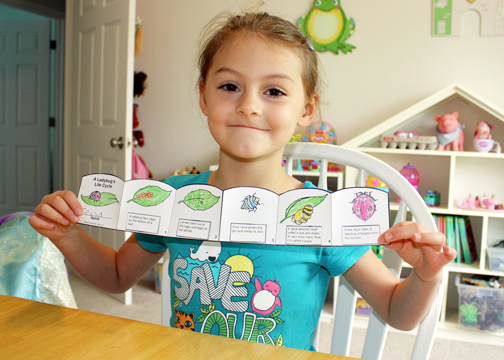
Tessa's completed "A Ladybug's Life Cycle" booklet shows the various stages of a ladybug's life cycle...from adult to egg to larva to pupa to ladybug. Later that day, she successfully identified both a ladybug larva and a pupa while playing outside.
Tessa's completed "A Ladybug's Life Cycle" booklet shows the various stages of a ladybug's life cycle...from adult to egg to larva to pupa to ladybug. Later that day, she successfully identified both a ladybug larva and a pupa while playing outside. 

Friday

Supplies for our mealworm house...oats, apple chunks, damp sponges, recycled plastic bucket and mealworms. The instructions called for damp paper towels, but I thought sponges might work better.

Tessa began creating our mealworm house by pouring oats into the recycled plastic bucket.

After adding the apple chunks and damp sponges, Tessa helped transfer the mealworms (darkling beetle larvae) to their new home.  We transferred sixty-four mealworms in all. We first thought some of our mealworms were dead. Turns out that what we were looking at were molted skins. Mealworms molt several times as they bridge from larva to pupa stage.
After adding the apple chunks and damp sponges, Tessa helped transfer the mealworms (darkling beetle larvae) to their new home.  We transferred sixty-four mealworms in all. We first thought some of our mealworms were dead. Turns out that what we were looking at were molted skins. Mealworms molt several times as they bridge from larva to pupa stage.

Our completed mealworm house. Now, we watch and wait. It can takes several months for a mealworm to complete its life cycle.

Tessa also observed a mealworm with a hand leans, drew a picture of it and then wrote a sentence about what it does in its new home.
Tessa also observed a mealworm with a hand leans, drew a picture of it and then wrote a sentence about what it does in its new home. 

Other Books of Interest

Saturday, June 01, 2013

Life Science, Week 25

Ocean Invertebrates

There are more types of invertebrates that live in the ocean than on land. Tessa learned about some of the most common ones this week.


Tuesday
  • Watched Oceans DVD by DisneyNature from Netflix.
This DVD isn't specifically about invertebrates. I had Tessa point out the invertebrates as we watched.


Wednesday
I had a hard time churning up good books about ocean invertebrates at our local library. I really like the No Backbone! series by Bearport Publishing. Our library had several from the series for land invertebrates but just one for ocean invertebrates. I've listed the others under "Other Books of Interest" below.


Friday
I would have loved to have had Tessa examine various ocean invertebrate specimens as suggested in "Take a Closer Look" (page 29), but I couldn't come up with any in our neck of the woods. Anything besides shrimp that is.

Our completed ocean invertebrates bulletin board (plus, a little something extra Tessa created on her own). I cut the background from construction paper and stapled it onto the bulletin board. Tessa was in charge of drawing the invertebrates. She drew a crab, jellyfish, sand dollar, sea anemone, and some mussels, sea stars and mollusks.
Our completed ocean invertebrates bulletin board (plus, a little something extra Tessa created on her own). I cut the background from construction paper and stapled it onto the bulletin board. Tessa was in charge of drawing the invertebrates. She drew a crab, jellyfish, sand dollar, sea anemone, and some mussels, sea stars and mollusks.  

Other Books of Interest

Friday, May 24, 2013

Life Science, Week 24

Invertebrates - Body Characteristics

I set out to create the live observation jars suggested in Evan-Moor ScienceWorks for Kids. After a day's attempt, I had only successfully caught worms, so I abandoned that idea. (To be fair, I did find random spiders, but I wanted orb spiders and I couldn't seem to turn up any of those.) Therefore, we used close-up pictures from books for some of our observations instead.

Quick note...the rhyme along books listed last on Monday, Tuesday and Thursday were just for fun. Don't knock yourself out trying to track down those.


Monday

Tessa's not fond of soft, squishy invertebrate types. She was content in letting our subject get away this day.
Tessa's not fond of soft, squishy invertebrate types. She was content in letting our subject get away this day. 

Tuesday
While I would have preferred an orb or wolf spider for Tessa to observe, I couldn't find either of those on short notice, so I ran down into our basement right before science and snatched up the first spider I came across. Guess where that spider is now? Back in our basement...Tessa insisted on it. After all, she argued, the basement is its home. Ugh.


Wednesday
All of the ant books we ordered from the library didn't arrive in time. Ants by Melissa Stewart wasn't very informative. I suggest finding something better.


Thursday

Friday

Other Resources of Interest

Friday, May 03, 2013

Life Science, Week 23

Invertebrates - Animals without Backbones

With clothes to wash, suitcases to pack and maps to print for our Arizona vacation, it was a one-day week for science. Luckily, the unit was super short and it worked out even though I was hoping to use the extra time to get a jump start on the next unit. Ah, well...could only do what I could do.


Tuesday

Other Books of Interest

Friday, April 26, 2013

It's Owl Week!

Before we started our study of the animal kingdom, I asked Tessa for a list of specific animals that she wanted to learn more about. One was owls. I was super excited to hear this because I have long wanted to dissect owl pellets. Owl pellets are essentially dried owl vomit. Owls often swallow their prey whole. Since they don't have teeth to grind up bones, fur, etc. and their digestive systems can't safely pass these parts, they must "gag" them up. Dissecting owl pellets is a fun, inexpensive and accessible way to study what owls eat. Doing so also reiterates the importance of predator-prey relationships and food webs.

I had the idea of tracking down appropriately leveled nonfiction readers for several of the animals on Tessa's previously mentioned list and designing lapbooks around them. I wanted Tessa to have the experience of completing research and the lapbooks themselves with minimal parental guidance. Unfortunately, I grossly misjudged the amount of time and effort it would take me to design said lapbooks. The owl lapbook shown below is the only one I was able to complete in time. I hope to get a couple more done in time for her to complete this summer.


Monday

Tuesday

Blue House School - Owls: A Little Learners Lapbook - Creating a woodland habitat for an owl was one of Tessa's favorite components. She opted to color it after assembly.
Creating a woodland habitat for an owl was one of Tessa's favorite components. She opted to color it after assembly.

Wednesday


Thursday

We ran short on time earlier in the week, so we decided to wait until all components were completed before gluing everything down.

Tessa's nearly completed Blue House School Owls: A Little Learners Lapbook. (She wanted to color the cover art after lunch, so we waited until then to glue it on.) This was her first lapbook. It's not perfect, but I think she did a pretty nice job. She's very proud of it. I especially love her drawing of a common screech owl.
Tessa's nearly completed Blue House School Owls: A Little Learners Lapbook. (She wanted to color the cover art after lunch, so we waited until then to glue it on.) This was her first lapbook. It's not perfect, but I think she did a pretty nice job. She's very proud of it. I especially love her drawing of a common screech owl.

Friday

Our Northwest Medium barn owl pellet right out of its foil packet.

Tessa used wooden probes and tweezers (and her fingers!) to dissect her owl pellet. It was like unwrapping a little furry present with lots of teeny treasures inside. I think she had more fun with this lab than any other this year.

A sampling of the bones we found. We ended up with three complete skulls, numerous bones of all sorts and a few pieces of what we think are insect exoskeletons. After comparing the bones to bone charts provided on Owl Brand Discovery Kit's Web site, we concluded that they are either mouse or rat bones...I'm guessing mouse.

Other Resources of Interest

Friday, April 19, 2013

Life Science, Week 22

Vertebrates - Home Builders

We finished up Evan-Moor ScienceWorks for Kids: Animals with Backbones, Grades 1-3 this week. Now, I have to make a decision...move onto Animals without Backbones, Grades 1-3 or stop for a month or so and study specific vertebrates more in depth. I really want to do the latter, but I'm worried about time. Having said that, we are taking next week to study owls, complete an owl lapbook I designed and dissect owl pellets.


Monday

Wednesday

Friday
I totally flaked on "Check for Understanding." I knew I was supposed to be collecting recyclables for some reason, but I couldn't remember what. By the time I remembered, it was too late. We didn't have enough around the house for Tessa to construct a home for her imaginary animal, so I just had her draw a home. It was way easier and took less time anyway.

Tessa's completed "Make a Report" and "Check for Understanding" drawings. Most of the time, I go in another room while Tessa independently works on her drawings. It's always a big surprise to see what she comes up with. I thought she did a pretty good job on these two.

Other Books of Interest

Saturday, April 13, 2013

Life Science, Week 21

Vertebrates - Forms of Self-Defense

Tessa learned many weird and interesting ways that animals defend themselves. I think her favorite was that opossums and hognosed snakes play dead.


Monday

Tuesday

Wednesday

Thursday

After finding plastic sea creatures that I hid around our school room (some camouflaged, some not), Tessa placed the non-camouflaged sea creatures onto more appropriate backgrounds and then explained how camouflage works.
After finding plastic sea creatures that I hid around our school room (some camouflaged, some not), Tessa placed the non-camouflaged sea creatures onto more appropriate backgrounds and then explained how camouflage works.  

Tessa colored a paper rabbit for "Camouflage Capers" to blend in with the background of her choice.
Tessa colored a paper rabbit for "Camouflage Capers" to blend in with the background of her choice.  

Friday

Other Books of Interest

Sunday, April 07, 2013

Life Science, Week 20

How Vertebrates Move & Footprints Too

Swing, slither and swim...Tessa learned vertebrates move in various ways. She also learned ways to identify animal tracks and made castings of those found around our house.


Monday

Tuesday

Tessa and I designed a bulletin board for "The Race Is On!" After I set up the race track, Tessa arranged the animals from slowest to fastest around the track.

Our completed bulletin board. The cheetah won, having sprinted to the finish line at 70 mph. The poor sloth never stood a chance. He crawled along at just 1.3 mph.

Wednesday

Friday

We found deer tracks in our backyard.

And, a couple of dog prints along a nearby pond.

Tessa carefully mixed and then poured plaster of Paris onto a deer print to make a casting.
Tessa carefully mixed and then poured plaster of Paris onto a deer print to make a casting. 

Note: After the castings fully dry and we knock the mud and dirt off of them, I will update with a picture of our final products.