Friday, June 22, 2012

What is a Star?

A nice thing about subscribing to Evan-Moor TeacherFileBox.com instead of buying individual books is that I can pull from various levels of the same curriculum series. While deciding between Everyday Literacy: Science, Grade K and Grade 1, I found that we had already covered most of the topics in Grade K with the science that we had previously used. Several topics were repeated in greater detail in Grade 1 as well. There were five topics from Grade K, though, that we hadn't really covered and I didn't want Tessa to miss them. I have been weaving those topics into the Grade 1 curriculum.

One such topic from Grade K was, "What is a Star?" I condensed the material to two days since the lessons were quite simple. The hands-on science activity is featured below. Tessa used seven silver stick-on stars, black construction paper and white chalk to recreate the Big Dipper constellation.

Guided by a photo on my Kindle Fire, Tessa recreated the Big Dipper constellation with silver stick-on stars and black construction paper.

Tessa wrote "Big Dipper" and dotted in other stars with white chalk.

Tessa's Big Dipper!
Tessa's Big Dipper!

Wednesday, June 20, 2012

Summer Reading Club!

A couple of weeks ago, we stumbled upon St. Louis County Library's summer reading club kick-off event at the Eureka branch. While I returned and picked out new books, Tessa enjoyed the balloon animals, face painting, crafts and snacks. I didn't know whether the program would excite Tessa at her age but figured why not. Well, it has! Tessa has been working hard reading extra books ever since. Today, she completed the first level of her passport by reading her eleventh and twelfth books. I was so proud of her, as she nearly read them fluently! (Not something that happens every day yet.) Hopefully, we'll be able to take her to collect her prize this weekend. She's super excited to see what it might be and has been making all sorts of guesses.

Tessa read "Jack and Jill and Big Dog Bill" and "Bob Books: As Big As" today to complete the first level of her summer reading passport.

Tuesday, June 12, 2012

Squinkies Make Fun Little Math Manipulatives!

One of our favorite math manipulatives are Squinkies! Among their many uses, they are perfect for making Singapore Math stories. If you have a child who loves these little plastic critters as much as Tessa, you know it doesn't take long to accumulate a couple hundred of them. While preparing lessons that require making math stories, I simple riffle through our Squinkies bin and match up a few handfuls that are easy to group into stories.

Tessa loves using Squinkies as math manipulatives!

Right now, Tessa's working on learning subtraction facts. The seven Squinkies above easily make several different subtraction stories.

There are seven animals. Four are dogs. Three are cats.  7 - 4 = 3
There are seven animals. Three are blue. Four are pink.  7 - 3 = 4
There are seven animals. One is a baby. Six are adults. 7 - 1 = 6
There are seven animals. Two are wearing hats. Five are not wearing hats.  7 - 2 = 5

Pretty fun, eh? Next time you dig one of these guys out of the couch and threaten to throw the whole lot in the trash, toss them into your math bin instead. We also use the over-sized balls that came as part of the Squinkies McDonald's Happy Meal toys as quick containers to hold the groups of regular-sized Squinkies that we use as math manipulatives.

Friday, June 08, 2012

Looking at Rocks

For this week's hands-on activity from Evan-Moor Everyday Literacy: Science, Tessa simulated the effects of weather on mock rocks. I formed the rocks from a mixture of coffee, coffee grounds, flour and salt ahead of time.

Mock Rocks
The coffee mixture made pretty convincing rocks. After a full day of basking in the sun, they dried nearly, well, as hard as rocks!

First, Tessa rubbed sandpaper over a rock to simulate wind blowing grains of sand against large rocks.

Tessa rubbed sandpaper on a mock rock.
Tessa rubbed sandpaper over a mock rock.

Next, she placed a rock in a jar of water and shook it to simulate waves crashing against a cliff.

After shaking a rock in a jar of water, Tessa checked for changes.

Finally, Tessa dropped and hit rocks together to see what would happen.

Tessa hit rocks together.
Tessa learned that when large rocks collide, they break into smaller rocks. In time, those smaller rocks turn into sand or soil.

A close-up of one of Tessa's changed rocks.

Tessa and I both greatly enjoyed this experiment. It well-suited her age and cemented in her mind the various ways rocks are changed by natural forces.

Friday, June 01, 2012

Parts of an Insect

We will be finishing up a little-known early elementary science program in the next month or so that I think is absolutely wonderful for the preschool/kindergarten set. This past fall, I had the worst time finding a meaty enough science curriculum for the kindergarten level, so I pieced together my own lessons. The process was extremely time-consuming. Our small local libraries have very limited resources, so I had to buy the majority of the books we used as well. At $5-6+ a picture book, one to two books per week, it added up fast. After purchasing a discounted yearlong subscription to Evan-Moor TeacherFileBox.com via Homeschool Buyers Co-op earlier this year, I stumbled upon Everyday Literacy: Science. We are using Grade 1, but there are three levels...Grade PreK, Grade K and Grade 1.

Everyday Literacy: Science, Grade 1 - We use a digital version.

Tessa absolutely adores Everyday Literacy: Science. While there is a short lesson for each day of the week, I condense them to three days (first two pages the first day, second two pages the second day and the hands-on activity the third day). Tessa literally bums out when I tell her, "Sorry, no science today." It's her favorite subject!

Everyday Literacy: Science is about as open-and-go as you can get for science. The final lesson each week features a hands-on activity that reinforces the week's science concept. They do require a bit of prep work but use basic household supplies, or materials that can be printed from the internet. The activities are perfect for the age. Everyday Literacy: Science is worksheet-intensive but requires no additional texts to be purchased. All content is written into the lessons. Concepts are presented in interesting and memorable ways. Tessa's retention has been remarkable. The worksheets require little-to-no reading and writing. They utilize very basic coloring, circling, underlining, dot-making, tracing, filling-in-the-bubble and similar skills. Aside from the hands-on activities, lessons take only five to ten minutes to complete.

This past week, Tessa learned about the parts of an insect. Today's hands-on activity required her to create an insect of her own design. She remembered that all insects have three main body parts (head, thorax and abdomen), two antennas and six legs.

Tessa rolled dough for the three main body parts of an insect...head, thorax and abdomen.

Tessa attached six legs (and later wings) to the thorax.

Tessa's completed insect of her own design.

A close-up of Tessa's insect...it's a fancy grasshopper.

Lollipop Logic & Evan-Moor Beginning Geography

After finishing up our regular school year, we picked up a couple of fun electives for the summer.

The first couple of chapters of Lollipop Logic: Book 1 have been quite tame. I'm curious to see how Tessa will do with some of the more challenging material later on in the book.


I'm glad we were able to squeeze in Evan-Moor Beginning Geography this summer. Tessa has really impressed me with how well she has done with it so far. We will be using History Odyssey: Ancients, Level 1 by Pandia Press this fall. My hope is the skills she's learning now will greatly benefit her then. History Odyssey requires weekly map work.

Number Line for Singapore Math 1A 3.3.1 Lesson & Game

Here's a number line I created for the Singapore Math 1A 3.3.1 lesson and game. (3.3.1 = Unit 3, Chapter 3, Lesson 1, which is on page 30 of the Singapore Math Primary Mathematics 1A STD ED Home Instructor's Guide.)

For the number line game, I had Tessa choose a Squinkies figure the night before without telling her why. (I like to keep her in suspense. Makes school more fun that way.) I was thinking a critter would be good, but no, she chose Ariel in her wedding dress. I pretty much had to choose Eric for myself then. So much for the cute little green dog with spots I had my eye on. I covered a blank die with pieces of cut up file folder labels and wrote +1, +2 and +3 on them. Sticking them on a regular die would probably work just as well.


Number Line for Singapore Math 1A 3.3.1 Lesson & Game

Download Number Line for Singapore Math 1A 3.3.1 Lesson & Game.

The game directions technically call for a 0-10 number line, but including the zero forced the number line to be too small for an 11" x 8.5" sheet of paper. It's easy enough to set the counters/game pieces before the one and play that way.

Ariel and Eric get ready to hop down the number line.
Ariel and Eric prepare to hop down the number line.

Wednesday, May 30, 2012

Flash Cards for Singapore Math 1A 3.2.2 Game

Unable to find the exact materials I needed for the Singapore Math 1A 3.2.2 game, I ended up creating my own. (3.2.2 = Unit 3, Chapter 2, Lesson 2, which is on page 27 of the Singapore Math Primary Mathematics 1A STD ED Home Instructor's Guide.) They were a bit of a pain in the rump to make, so I thought I'd share. The free downloadable PDF file includes flash cards for all addition facts through 5, +0 and +1 as well as all corresponding answers. (See chart on page 25 of the aforementioned Home Instructor's Guide.)  You may wish to tailor what you print to best fit your needs.

Flash Cards for Singapore Math 1A 3.2.2 Game

Download Flash Cards for Singapore Math 1A 3.2.2 Game.

For a shorter game, print pages 1-7 (expression cards) and 11-17 (answer cards), then weed out the duplicate reversed order expression cards. (See chart on page 25 of the aforementioned Home Instructor's Guide. This will print expression and answer cards for the first three columns.) There will be a few extra cards at the end of each printed group. Discard those too.

For expression cards only, print pages 1-11. Discard the answer cards that print out on the last page. (See chart on page 25 of the aforementioned Home Instructor's Guide. This will print the expression cards only for the entire chart.)

At one point, Tessa ended up with a BUNCH of answer cards. I really thought I had shuffled better than that.

The entire deck looked as though it might be a bit much for Tessa, so I decided to use the cards for the shorter game the first time around. We went ahead and used them all the second day. It went well enough, but she was a bit antsy by the end. Me too! Overall, Tessa really liked this game.

Monday, May 28, 2012

Blank Number Bonds Worksheet

Found this wonderful blank number bonds worksheet by fivej's when Tessa started studying number bonds a couple of weeks ago in Singapore Math 1A. Thought I'd share. It's so nicely designed!

Blank Number Bond Worksheet by fivejs.com.

Thursday, May 24, 2012

Finally! Handwriting We Like...I Think

If I would have started this blog a couple of months ago, I would have written a lot about our handwriting struggles. Handwriting Without Tears for Kindergarten was perfect for Tessa. I have no complaints. Used with the key components, it's a very good program, especially for young learners. However, Handwriting Without Tears for Grade 1 was a flop for both of us. I started loathing their signature double lines. From watching Tessa write during other subjects, I knew her handwriting could be quite good for her age, but I just wasn't seeing it during handwriting. Half of the first grade workbook is pretty much identical to the kindergarten one. I guess it's good to be consistent and familiar, but for us, it was just too much of the same ole thing. Granted, it may not be as bad for students who don't school year-around or jump right into the next level.

Handwriting Without Tears: First Grade Sample
Handwriting Without Tears for Grade 1 - Without headlines, Tessa's tall letters are inconsistent and often way too tall.

After looking and thinking, looking and thinking, I finally bought a Zaner-Bloser for Grade 1 handwriting workbook for her. The font isn't too terribly different. I had Tessa continue to form letters the Handwriting Without Tears way. The pages are four-color, feature cute little illustrations and the lessons are easy to divide into smaller portions. It was a breath of fresh air...for about a week. What was the problem? Zaner-Bloser prints on high-gloss paper, which is very SLICK. In addition to concentrating on proper letter formation, Tessa worried about her pencil slipping across the page. It wasn't worth the frustration. We had no choice, we chucked it. After a one-day jump back to the Handwriting Without Tears for Grade 1 workbook (needless to say, that didn't go so well...again), I decided to copy the remaining Handwriting Without Tears for Grade 1 content into ZB FontsOnline Plus, which is Zaner-Bloser's wonderful free online worksheet maker. I love that I can adjust the line spacing by choosing different grade levels.
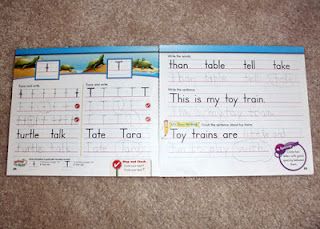
Zaner-Bloser: Grade 1 Sample
Zaner-Bloser for Grade 1 - Zaner-Bloser uses four-color printing, features cute illustrations and the lessons are easy to divide. Tessa completed these pages over five days. Unfortunately, Zaner-Bloser prints on high-gloss paper, which is very slick and caused Tessa needless frustration.

ZB FontsOnline Plus Sample
ZB FontsOnline Plus - A worksheet I created using Zaner-Bloser's free online worksheet maker. I copied the remaining Handwriting Without Tears for Grade 1 content into the program. I wanted to use Handwriting Without Tear's worksheet maker for the font, but they do not currently offer a triple-line option as far as I can tell.

We pressed on with my revised Handwriting Without Tears worksheets. Every time I pulled one out, Tessa broke out into a fit of uncontrollable itches and yawns. It was a struggle for her to form one full letter without some part of her body itching. I took this as a sign that I needed to find something drastically different. More looking and thinking...

Thank you, Scholastic Teacher Express Dollar Deals! Hiding within categories I never would have thought to look in for handwriting curriculum, I found these (plus, a few others for later).


Scholastic Mini-Dictionaries eBookScholastic Guess-Me Poems & Puzzles: Alphabet eBook Scholastic ABC's Mini-Books eBook

Scholastic ABC Stationery eBookScholastic Phonics Stationery eBook

We started 15 Reproducible Cut & Paste Mini-Dictionaries this past week. I divided the words among three days, so Tessa copies five themed words every other day. She also hones her hand and finger muscles by coloring, cutting and pasting the corresponding pictures into the booklet. Although I think she knows, I've been careful not to call it handwriting. I think I'm on the right track, as she actually asked to work on her mini dictionary first the second day. My plan is to rotate the eBooks above every couple of weeks to stem off monotony.

After writing the selected words, Tessa colored the corresponding pictures.

Then, she cut them out.

Finally, Tessa pasted the pics into her mini-dictionary.
Finally, Tessa pasted the pics into her mini dictionary. 

Update: We have since abandoned most of the Scholastic eBooks mentioned above. As fun as they were, the line-spacing used in them is ginormous. After trial and error, I discovered Tessa's handwriting is better when smaller. I switched back to creating my own handwriting worksheets with ZB FontsOnline Plus. I use the line spacing for Grade 3. In addition to copying specific letters and words, I allow her to practice a little creative writing...she gets to create her own sentences using words she selects from word banks. Handwriting is going quite a bit better now.