Saturday, September 28, 2013

Rock & Mineral Study Kits

It just occurred to me that I haven't mentioned what study kits we have been using to conduct our rock and mineral labs.

After extensive searching this past summer, I ordered the following kits from Home Science Tools. I have been 100 percent happy with them. Be sure to check the Web for a coupon before ordering!

Also, if your community has a cave nearby, check their gift shop for specimens.

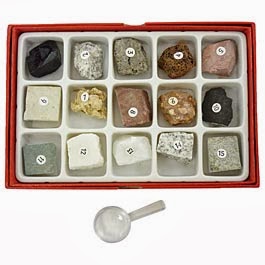
Rock Study Kit, 15 Specimens

Mineral Study Kit, 15 Specimens

Geology Field Trip in a Bag - We use these specimens for general sorting, etc. activities where it's not imperative that we know what the specimens are. We also use them for activities involving water. The samples from the other kits have paper identification tags attached to them.

Earth Science: Geology, Unit 4

Properties of Rocks

Studying the properties of rocks was an absolute blast this week! Through a variety of hands-on labs, Tessa learned about the colors and patterns of rocks and minerals, measured their sizes and weights, and performed tests to determine their hardness and buoyancy.


Tuesday

Tessa sorted rocks and minerals by various characteristics of her choosing.

Tessa has long been infatuated with rocks. For years, she has picked up "special" rocks on our walks to and from the mailbox. So, for the "Rock Hounds" portion of this lesson, she went straight to her "rock garden" to collect samples.

Wednesday

Following Monday

After arranging a selection of rocks by her perception of smallest to largest, Tessa measured the rocks and recorded their actual sizes. To do so, she wrapped pieces of yarn around their widest points, then measured the cut lengths. She was surprised to learn that her perception was drastically off in some cases.
After arranging a selection of rocks by her perception of smallest to largest, Tessa measured the rocks and recorded their actual sizes. To do so, she wrapped pieces of yarn around their widest points, then measured the cut lengths. She was surprised to learn that her perception was drastically off in some cases. 

Afterward, Tessa used a balance to weigh the same rocks and recorded their weights.
Afterward, Tessa used a balance to weigh the same rocks and recorded their weights. 

Following Tuesday

Tessa loved performing scratch tests to determine the hardness of a sampling of minerals. She attempted to scratch them first with her fingernail (hardness of 2.5), then a copper penny (hardness of 3) and finally an iron nail (harness of 5).

Following Wednesday

Thursday, September 26, 2013

Medieval Times, Lesson 5

Islam

Tessa learned the origins and basics of Islam.


Wednesday

Thursday
  • Read "The Story of Islam" (pages 32-41) from What I Believe by Alan Brown.
  • Read Ramadan by Suhaib Hamid Ghazi.

* HO = History Odyssey

Friday, September 20, 2013

Medieval Times, Lesson 4

Monks of the Christian Church

Tessa learned that Christian monks from the Middle Ages had to follow many rules and were responsible for the tedious work of copying and creating manuscripts with intricate drawings. After crafting her own illuminated letter, she understood a little better just how much work that entailed. 


Wednesday

Thursday
The Last Snake in Ireland: A Story about St. Patrick is tongue-in-cheek and very much just for fun. There are much better books about St. Patrick available (perhaps Patrick: Patron Saint of Ireland by Tomie dePaola or St. Patrick's Day by Gail Gibbons). I chose this one because it was recommended in The Story of the World Activity Book, readily available and we hadn't already read it.


Friday
I really wanted to read Marguerite Makes a Book by Bruce Robertson before our illuminated letter craft. I had it on hold at the library for weeks. Of course, my number came up while we were on vacation earlier this month, so I missed my chance. I made do with Magic in the Margins: A Medieval Tale of Bookmaking, which wasn't bad...just wasn't what I wanted.

Tessa began by sketching a pattern for her illuminated letter. Then, she filled it in with Prismacolor colored pencils. Our set included a nice metallic gold. After diligently working on her letter for an hour, I took pity on Tessa's cramped hand and helped her with the final detail work. I used a metallic gold Jelly Roll pen to outline the gold sections. We took turns adding the gold dots.
Tessa began by sketching a pattern for her illuminated letter. Then, she filled it in with Prismacolor colored pencils. Our set included a nice metallic gold. After diligently working on her letter for an hour, I took pity on Tessa's cramped hand and helped her with the final detail work. I used a metallic gold Jelly Roll pen to outline the gold sections. We took turns adding the gold dots.  

Tessa's completed illuminated letter. Tessa was really into this project, which surprised me a bit. She was quite proud of her work and couldn't wait to show Daddy.

Lucky for us, the illuminated letter modeled in "The Middle Ages: Come and Discover My World" was the letter "T"...perfect for a girl whose name begins with "T". I thought the vines and leaves pictured were beyond Tessa's skill level, so I had her draw some simple flowers instead.

* HO = History Odyssey

Saturday, August 31, 2013

Medieval Times, Lesson 3

Charlemagne

After learning about the Franks and Charlemagne, Tessa enjoyed hearing classic tales set around the time and in the land of Charlemagne's empire. While the fairy tales weren't new to Tessa, she especially enjoyed the versions we read.


Wednesday

Thursday
We ran out of time this week to read Knights of the Round Table by Gwen Gross during school time, so we will read it as a read-aloud at bedtime in the coming days.

* HO = History Odyssey

Medieval Times, Lesson 2

The Byzantine Empire

After learning about the Franks and Charlemagne, Tessa enjoyed hearing classic tales set around the time and in the land of Charlemagne's empire. While the fairy tales weren't new to Tessa, she especially enjoyed the versions we read.


Friday

Following Friday
  • Worked on Blue House School Byzantine Bean Mosaic.

The pattern I designed for our project is based on a picture of a section of Byzantine marble mosaic bathhouse floor I found online at The Met.

Tessa worked diligently on her part of the bean mosaic. (This was definitely a two-person project. It took several hours to complete. The end result would have looked nicer if the design would have been traced onto a board or other medium that would not have been affected by the wetness of the glue.)

* HO = History Odyssey

Wednesday, August 28, 2013

Earth Science: Geology, Unit 3

How Soil Is Made

Tessa learned how soil is made with some quick-and-easy hands-on activities.


Tuesday

Tessa examined a cup of soil to discover what soil contains. She sorted the things she found into three piles...once living, living and nonliving.

The majority of what Tessa found where once living things. Among them were a decaying leaf, root fragments, an acorn and pieces of wood.

Wednesday

Tessa helped bury a mesh sack full of vegetable and fruit scraps in an empty plot in the garden. We'll check back in three months to see what happens when plants decay.

Other Resources of Interest
  • Dirt - Ellen Lawrence

Monday, August 26, 2013

Earth Science: Geology, Unit 2

The Earth's Crust

Unit 2 was an easy (and fun) one-day study of the Earth's crust. Tessa enjoyed going outside to collect things on the Earth's crust.


Monday

Paper lunch bag in hand, Tessa set off to collect things that are on the Earth's crust.
Paper lunch bag in hand, Tessa set off to collect things that are on the Earth's crust. 

Tessa sorted her finds into two piles...things that are part of the Earth's crust and things that are on the Earth's crust. Then, she sketched the items on a record sheet. She indicated that rock and soil are the only two things that are part of the Earth's crust.

Saturday, August 24, 2013

Medieval Times, Lesson 1

Overview of the Medieval World

As mentioned in my Earth Science, Unit 1 post, we are continuing with the four-year cycle for both history and science this year. Second year history is Medieval Times. That means we will study the events and people from about A.D. 500 to A.D. 1500 with most events having taken place in Europe.

Once again, we are using Usborne, History Odyssey and The Story of World Activity Book as the basis of our yearlong study. I am not overly impressed with Days of Knights and Damsels: An Activity Guide by Laurie Carlson that is recommended in History Odyssey. After considerable research, I found there really isn't much choice in the way Medieval craft books for children, though. I'm hoping to find or create my own crafts and activities along the way. I also purchased the recommended Coloring Book of the Middle Ages by Bellerophon Books, although I'm not sure why. I don't think we'll have a lot of time to color. I think it's more fruitful for Tessa to draw and narrate a few sentences every now and again.


Due to our need to keep a tight schedule this year, we will study history a strict three times per week. Last year, I tried to complete a unit/lesson per week. This year, we will simply do whatever is next on the schedule. Sadly, I think this will cut back on the depth of our studies, so I will have to be a bit pickier about our book, video and craft selections. As a result, I will list our blog posts by lessons (as they correspond with History Odyssey) instead of weeks this year.

Note: We will not complete any of the dictionary work for History Odyssey this year. Last year, we discovered that the time commitment was not worth the academic reward. We will leave dictionary work for language arts time.  


Wednesday
We don't own a copy of The Usborne Encyclopedia of World History since I like using the smaller period-specific versions of the encyclopedia. Our The Usborne Medieval World doesn't have the full introduction for Medieval Times, though, so I checked out a copy of the big book from the library for this lesson.

Also, I bought a used copy of The Kingfisher Atlas of the Medieval World to use as a geography supplement this year. I thought it looked like fun online. After reading it for this week's lesson, I'm dumping it. As it turns out, it's rather boring and isn't very cohesive.


Thursday
Tessa and I both really enjoyed this book. I plan on keeping it around to complete a couple of the crafts later on.

Friday, August 23, 2013

Earth Science: Geology, Unit 1

The Earth Has Layers

We are continuing with the four-year cycle for both science and history this year. That means it's Earth science for us! Our yearlong study of the Earth will be broken down into three segments...geology, weather and space.

We had a really good experience with Evan-Moor ScienceWorks last year, so we will continue with it for Earth science as well. Evan-Moor doesn't have an appropriately-aged ScienceWorks book for weather, so we will use a resource from The Mailbox for that segment.

Geology - Evan-Moor ScienceWorks for Kids: Geology, Grades 1-3
Weather - The Mailbox Investigating Weather, Grades 1-3
Space - Evan-Moor ScienceWorks for Kids: Exploring Space, Grades 1-3

I'm feeling conflicted as to how to organize the science portion of our blog this year. Last year, I posted by the week. Each week typically featured one unit's worth of work. We added a complete language arts program to Tessa's schedule this year, so that has increased her daily workload by a good bit. Unfortunately, this means we have to tighten our schedules for science and history. Except for very rare occasion, we will study science a strict three days per week. That means, some weeks we will cover two units and other weeks we will split one unit over two (or even three) weeks. So, what I'm trying to say with all of my rambling is that I think it makes more sense to post by the unit this year.

Here we go...unit one!


Monday

Tuesday

Tessa thought this simple paper craft was pretty cool. She moved "The Magic School Bus" through the layers of the Earth!

Wednesday
Since the record sheet that goes along with the "Clay Models..." activity was a lot like The Magic School Bus activity Tessa completed on Tuesday, I had her sort and label the layers of the Earth with the free Layers of the Earth Nomenclature Cards from The Helpful Garden. I printed them in black and white and then colored them by hand to match the layers from the "Clay Models..." activity.

Using modeling clay, Tessa created a model of the Earth with secret layers inside.
Using modeling clay, Tessa created a model of the Earth with secret layers inside. 

Tessa wasn't very happy about cutting open her model. After explaining that was the whole point of making it, she correctly identified the layers...inner core (red), outer core (yellow), mantle (orange) and the Earth's crust (blue and green).